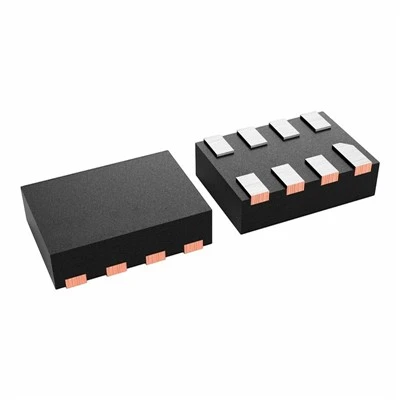
Introduction to I/O Expander IC
I2C is a synchronous serial communication bus specifically designed for connecting low-speed peripheral devices in embedded systems. It requires only two signal lines to implement bidirectional communication between connected devices: the Serial Data Line (SDA) is responsible for transmitting actual service data, while the Serial Clock Line (SCL) outputs synchronous clock signals to coordinate communication timing. I2C employs a multi-master multi-slave architecture, which allows multiple master devices and multiple slave devices to be connected to a single bus simultaneously, and permits any master device to initiate communication processes. Each slave device on the bus is assigned a unique 7-bit or 10-bit address, through which the master identifies the target slave device for communication. This design removes the need for additional chip select signal lines, resulting in simple and clear hardware wiring. I2C communication uses an open-drain output mode, and external pull-up resistors are required to ensure normal level output. Per the specification, the communication rate of I2C is divided into Standard Mode (100 kbps), Fast Mode (400 kbps) and High-Speed Mode (3.4 Mbps), which can satisfy the communication requirements of the vast majority of low-speed peripherals. Typical application scenarios include connections between the main control chip and devices such as EEPROM memory chips, various sensors (e.g., temperature sensors, acceleration sensors), OLED displays, and Real-Time Clocks (RTCs).
SPI is a full-duplex synchronous serial communication bus that adopts a master-slave architecture, and is generally composed of one master device and one or more slave devices. Basic communication requires four signal lines: Master In/Slave Out (MISO), which is responsible for transmitting data from the slave device to the master device; Master Out/Slave In (MOSI), which is responsible for transmitting data from the master device to the slave device; Serial Clock (SCK), which generates clock signals from the master to achieve communication synchronization; and Slave Select (SS), where the master pulls the level low to select the target slave device, and unselected slave devices will not respond to bus communication. SPI supports full-duplex simultaneous data transmission, does not require a complex address addressing process, and features a simplified communication protocol. Furthermore, the communication rate of SPI is significantly higher than that of I2C, and can usually reach tens of Mbps or even higher, making it suitable for application scenarios with high requirements for transmission speed. Currently, there is no unified official standard specification for SPI, and slight differences exist in the communication timing of devices from different manufacturers. When multiple slave devices are connected, connection can be implemented either through independent chip select lines, or cascading in a daisy-chain configuration. Common application scenarios include high-speed peripherals such as SPI Flash memory chips, LCD displays, ADC analog-to-digital conversion chips, and network chips.
I/O Expander IC is the most basic programmable pin integrated on microcontroller and microprocessor chips. The pin function can be configured via software, and it can directly implement level output and level reading without external dedicated communication interface circuits. When configured in output mode, GPIO can output two states, namely high level and low level, for controlling external devices; when configured in input mode, it can read the high and low levels input by external circuits to obtain state signals of external devices. Some GPIOs also support multiplexing functions, which can be configured as pins of specific communication interfaces, and also support special functions such as external interrupt triggering and Pulse Width Modulation (PWM) output. GPIO features flexible and convenient application with low hardware development costs, and is the most widely used I/O interface in embedded systems, which can adapt to various simple low-speed input and output requirements. In addition to direct connection to ordinary switches and indicator lights, developers can also simulate communication timing through GPIO, and implement serial communication protocols such as I2C and SPI via software, so as to satisfy the adaptation requirements of special hardware scenarios.
Specific models of I/O Expander IC
The TCAL6416 device provides general-purpose parallel input/output expansion for the two-wire bidirectional I2C bus protocol. The operating supply voltage range of this device is 1.08 V to 3.6 V for VCCI on the I2C bus side, and 1.08 V to 3.6 V for VCCP on the P-port side.
This device supports I2C clock frequencies of 100 kHz (Standard Mode), 400 kHz (Fast Mode) and 1 MHz (Fast+ Mode). When additional I/O resources are required for devices such as switches, sensors, buttons, LEDs and fans, I/O expanders represented by TCAL6416 can provide a concise and effective solution.
I2C and SPI General-Purpose I/O (GPIO) Parameters
The I/O Expander IC parameters are as follows:
|
Number of I/Os |
16 |
|
Features |
1-MHz maximum frequency, Adjustable I/O level, Configuration registers, Interrupt pin, Reset pin |
|
Addresses |
2 |
|
Rating |
Catalog |
|
Frequency (max) (MHz) |
1 |
|
Operating temperature range (°C) |
-40 to 125 |
Hot Tags: i/o expander ic, China i/o expander ic manufacturers, suppliers, Fiber Optic Network ICs, I O Expander IC, I2C And I3C Level Shifters Buffers And Hubs, I2C And I3C Switches And Multiplexers, i2c i3c and spi ics, RS 485 And RS 422 Transceivers